


Timelines 10
Man and his Senses 10
Man and his Inventions 10
Geography 10
Fauna 10
Timelines 10
Man and his Senses 10
Man and his Inventions 10
Geography 10
Fauna 10
Turn the pages of history to a time when the Mughal Empire ruled the plains of India at its height. Shah Jahan was commissioning the Taj Mahal in Agra, shaping a marble monument to memory and love. Yet while white domes were rising across the plains, something equally dramatic was unfolding in the Himalayan valleys above. There, no mausoleum was being built. Instead, an entire nation was taking shape.
Today, we revisit a compelling chapter of medieval South Asian history. On one side stood the imperial power of the Mughal Empire. On the other was a determined ruler, Prithvi Narayan Shah, who was steadily unifying Nepal into a single political entity. This story is not only about warfare; it is also about trade, architecture, and statecraft. A recent report dated 11 January 2026 has once again drawn attention to this period. To understand it fully, we must return to the year 1768, when the political map of South Asia was undergoing a lasting transformation.
What was the decisive strategy used to capture the Kathmandu Valley?
The Mughal Empire was renowned for its vast armies and powerful artillery. Warfare in the mountains, however, followed a different logic, where strategy often mattered more than sheer force. Prithvi Narayan Shah, widely regarded as the founder of modern Nepal, understood this reality better than most. His objective was clear: to gain control of the Kathmandu Valley, which was then ruled by the Malla kings.
In 1768, he adopted a military strategy that overcame the resistance of the Malla rulers without launching a direct assault on the city. Rather than attacking Kathmandu itself, he targeted its vital supply lines. Prithvi Narayan Shah imposed a blockade on the major trade routes that brought essential goods into the valley. With access to grain and salt cut off, the valley eventually had little choice but to surrender. This victory was achieved not through brute force alone, but through careful planning and strategic insight. It ultimately laid the foundation for the Shah dynasty and the unification of Nepal.
Why were these mountain routes so crucial?
At first glance, it may seem surprising that blocking a few routes could bring down powerful rulers. Yet these were no ordinary paths. They formed part of the Himalayan Silk Road, which served as the backbone of Nepal’s economy at the time.
Historical records from Nepal show that these routes functioned as crucial trade corridors linking Tibet with the plains of India. Through these mountain passes flowed Tibetan wool and, most importantly, salt, which was then transported to the Indian plains. In return, spices and textiles traveled from India up into the Himalayan regions. Control over these trade routes meant control over economic prosperity itself. Prithvi Narayan Shah recognized this strategic vulnerability with remarkable clarity. He understood that weakening the Malla kings required cutting off the economic lifeline that sustained their power.
Mughal domes or Nepali pagodas: who ruled architecture?
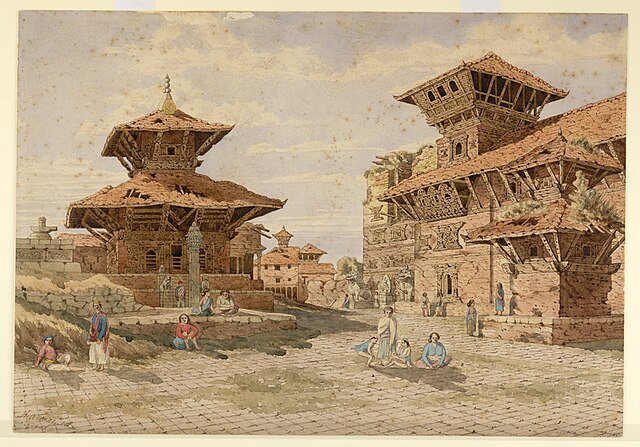
The contest of that era extended beyond the battlefield into the realm of art and beauty. While Mughal builders in India were shaping marble domes and elegant minarets, the Malla kings of Nepal were creating architectural masterpieces from brick and wood.
Kathmandu Valley’s Durbar Squares still stand as living testimony to that period. Under the Malla rulers, the pagoda style reached a remarkable level of refinement. UNESCO records describe how this architectural form developed a distinctive identity within Asian architecture. Whereas Mughal aesthetics emphasized grand scale and luminous white marble, the Malla tradition focused on intricate woodcarving and the disciplined use of brick. Even today, visitors to Kathmandu encounter temples of timber and brick that were already displaying their magnificence during the same era in which the Taj Mahal was being constructed.
Cultural exchange: were the mountains and plains influencing each other?
Despite their stylistic differences, art has rarely respected political boundaries. Studies highlighted by the Metropolitan Museum of Art suggest that this period witnessed significant cultural exchange between India and Nepal.
While Mughal art carried strong Islamic influences and Malla art was rooted in Hindu and Buddhist traditions, both traditions flourished during the same era. Malla artists maintained a distinct artistic identity, yet they were not isolated from the artistic developments taking place in neighboring India. It was a remarkable age for creativity, when a culture nurtured in the Himalayas was quietly shaping its own artistic narrative.
Did the Gorkha state fear the Mughals or the British?
Prithvi Narayan Shah’s Gorkha state sought more than the unification of Nepal. Its strategic vision was shaped by two major challenges. To the south lay the vast Mughal Empire, which was later replaced by the expanding power of the British. To the north stood China.
The expansion of the Gorkha kingdom therefore followed a carefully measured path. Through a deliberate geopolitical strategy, Nepal managed to remain independent of both powers. It did not fall under Mughal authority, nor did it come fully under British control in the later colonial period. By skillfully using its mountainous geography and maintaining a careful diplomatic balance, the kingdom was able to preserve its autonomy and avoid colonial domination.
Why is an eighteenth-century king being remembered in 2026?
This brings us to the present. On 11 January 2026, Nepal observed Prithvi Jayanti and National Unity Day across the country. According to reports, this year’s commemoration carried particular significance.
Public discussions revisited the continuing relevance of Prithvi Narayan Shah’s eighteenth century Divya Upadesh. In his reflections, he famously described Nepal as “a yam between two stones,” referring to its position between two powerful neighbors, India to the south and China, historically including Tibet, to the north. The metaphor illustrates Nepal’s delicate position between two large powers. Conversations surrounding the 2026 observance emphasized that in today’s diplomatic environment, where both India and China hold major global influence, this principle of maintaining balance remains a central guide for Nepal’s foreign policy.
This, then, is the story of a time when the Taj Mahal was rising in India while a nation was taking shape in Nepal. Prithvi Narayan Shah’s victory in 1768, the vital trade routes carrying salt and wool across the Himalayas, and the enduring temples of brick and wood together helped shape the South Asia we recognize today.
The transformations of the eighteenth century laid the foundations of the modern political landscape. Whether in 1768 or in 2026, history reminds us that strategies formed in the mountains continue to influence the present. The image of Nepal as a “yam between two stones” remains a powerful symbol of resilience, a nation standing firmly on its own ground with enduring pride.
Sources:
https://tinyurl.com/29ccjrvp
https://tinyurl.com/2bd5w6xx
https://tinyurl.com/23fuqqal
https://tinyurl.com/2dc24h3g
https://tinyurl.com/28jaj74w
https://tinyurl.com/27rcoo8t