


Timelines 10
Man and his Senses 10
Man and his Inventions 10
Geography 10
Fauna 10
Timelines 10
Man and his Senses 10
Man and his Inventions 10
Geography 10
Fauna 10
Long before borders were drawn on maps, a remarkable journey began that forever connected India and Nepal. This story begins in the plains of the Tarai in Nepal, where a prince named Siddhartha was born. Yet Siddhartha was not born into an ordinary kingdom, but into a unique republic.
Today, we travel back to a time when one of the earliest glimpses of collective governance appeared at the foothills of the Himalayas. We will follow the path from Siddhartha leaving his palace to his search for truth that led him to Bodh Gaya in present day Bihar. We will also explore the journey of Emperor Ashoka, who left a lasting mark on history by declaring Lumbini a tax free region. Finally, we will look at the discoveries from excavations in May 2025 that have brought new evidence about Buddha’s childhood home.
Let us walk along this path, which even today remains the spiritual spine connecting India and Nepal.
Was Buddha’s Father Really a Dictator King?
We often hear in stories that Buddha was the son of a king, but history suggests something slightly different. Siddhartha was born into the Shakya Republic, a political system that differed greatly from the absolute monarchies we usually imagine.
According to the Vipassana Research Institute, the Shakya clan functioned as a Gana Sangha. In such a system, authority did not rest with a single ruler. Instead, decisions were taken collectively by a council of elders and respected members of the community. This society, located in the foothills of the Himalayas, represented an early form of participatory governance. Matters were settled through discussion and consensus rather than by the command of a single king. Siddhartha grew up in this environment, where he encountered the early ideas of justice, dialogue, and shared responsibility.
Why Did the Prince Leave His Palace Overnight?
Born in the gardens of Lumbini, Siddhartha’s early life was surrounded by comfort and privilege. Yet at the age of 29, he chose to leave everything behind. In history, this moment is known as the Great Departure, or Mahabhinishkramana.
According to historical accounts, Siddhartha’s search for truth began after he witnessed the realities of old age, sickness, and death. Deeply moved by human suffering, he left his father’s palace in Kapilavastu and set out on a spiritual journey. Traveling south toward the plains of what is now India, he began a long quest for understanding. After years of wandering and intense meditation, Siddhartha finally attained enlightenment beneath a peepal tree in Bodh Gaya, in present day Bihar. At that moment, Siddhartha became the Buddha. His journey created one of the earliest spiritual links between Nepal, his birthplace, and India, where he attained enlightenment and began teaching his path to the world.
What Did Emperor Ashoka Write on Stone in Lumbini?
Several centuries after the Buddha’s lifetime, the Mauryan Empire rose to prominence in India. Emperor Ashoka, who renounced violence after the Kalinga War, dedicated himself to spreading the teachings of the Buddha. His adoption of Buddhism brought a profound cultural transformation across both India and Nepal.
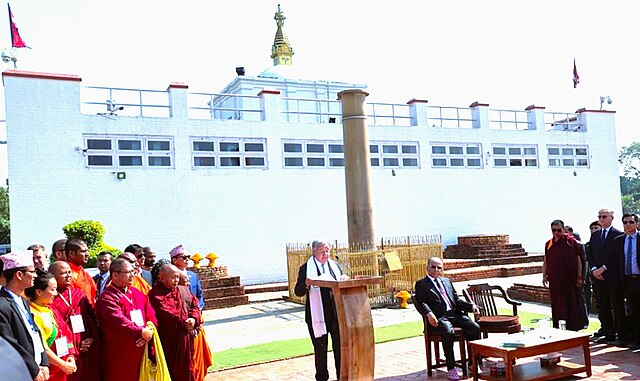
In 249 BCE, Ashoka undertook a pilgrimage and traveled to Lumbini, in present day Nepal, the birthplace of the Buddha. There he erected a massive stone pillar. UNESCO records note that a remarkable inscription was carved on this pillar in the Brahmi script. It reads: “Hida Budhe Jate Shakyamuniti,” meaning “Here the Buddha, Shakyamuni, was born.” Ashoka’s gesture did not end with the pillar. He also granted a significant privilege to the village of Lumbini by reducing its taxes to one eighth of its agricultural produce. Historians often view this act as one of the earliest recorded economic arrangements linking the regions that today form India and Nepal.
What Was Found Under the Ground in May 2025?
Now let us turn to the present day. History does not live only in books; much of it lies buried beneath the ground. In May 2025, a major development stirred the world of archaeology. According to a report by Smithsonian Magazine, modern excavations in Lumbini and Tilaurakot have revealed new insights into the life of the Buddha.
Using advanced technologies, scientists were able to determine the age of structures dating back to the period associated with the Buddha. These excavations provide strong evidence that an organized urban settlement existed during the time traditionally linked to his life in the sixth century BCE. The discoveries announced in May 2025 offer scientific support to long held historical accounts, suggesting that the early years of Siddhartha’s life unfolded within the settlements that once stood among these ancient walls and foundations.
Is Tilaurakot the Real Kapilavastu?
For many years, historians debated the exact location of Kapilavastu, the capital city of Siddhartha’s father. Recent findings and reports from the Lumbini Development Trust have helped clarify this long standing question.
According to these reports, the archaeological remains discovered at Tilaurakot strongly indicate that this was the ancient city where Prince Siddhartha spent his early years. The fortifications, gates, and residential structures uncovered at the site reflect the scale and organization of that period. These ruins are more than fragments of the past; they stand as silent witnesses to the moment when a young prince left his home in search of a path that would ease human suffering.
This is the story of a spiritual journey that began in the republican system of the Shakya clan and later found recognition in the stone inscriptions of Emperor Ashoka. Although Siddhartha was born in the plains of Nepal, the enlightenment he attained in India transformed his teachings into a message for the world.
Today, when we read about the archaeological discoveries announced in May 2025 or stand before the Ashoka Pillar in Lumbini, we are reminded that India and Nepal are more than neighboring countries. They are connected by the footsteps of the Buddha, taken thousands of years ago, yet still guiding the shared spiritual heritage of both lands.
Sources:
https://tinyurl.com/23bmy6j5
https://tinyurl.com/24wsol7f
https://tinyurl.com/y4slogbw
https://tinyurl.com/2d95fx7z
https://tinyurl.com/28lw8wge
https://tinyurl.com/2a2rsj6k