


Timelines 10
Man and his Senses 10
Man and his Inventions 10
Geography 10
Fauna 10
Timelines 10
Man and his Senses 10
Man and his Inventions 10
Geography 10
Fauna 10
What happens when a great civilization disappears? Do its people simply fade into history, or do they carry their lives forward and reshape their future on new lands? To find the answer, we must return to around 1900 BCE, a moment in history when the bustling cities of one of the world’s most advanced societies, the Indus Valley Civilization, began to fall silent.
Yet this silence did not mark an end. It signaled a new beginning.
This is the story of a vast human migration that quietly reshaped the relationship between India and Nepal, a connection that continues to endure. It is the story of people moving away from drying riverbeds toward fertile plains, driven by resilience and necessity, and of historical ties resurfacing in 2025 through what we now recognize as the Ram Janaki tradition.
Why Did the Great Cities of the Indus Valley Fall Silent?
Thousands of years ago, settlements along the Indus River stood far ahead of their time. But around 1900 BCE, nature began to change its course. According to scientists and historians, shifts in monsoon patterns reduced the flow of the rivers that had sustained this civilization. Climate change and prolonged drought gradually tightened their grip, draining the life from once thriving cities.
For the inhabitants of Harappa and Mohenjo daro, the choice became stark: remain and face decline, or move in search of water and fertile land. They chose to move.
This migration unfolded from west to east. Leaving behind the drying banks of the Indus, people gradually moved toward the fertile Gangetic plains and the foothills of the Himalayas. It was not simply a relocation, but a turning point that permanently shifted the center of civilization within the Indian subcontinent.
How Did New Cities and Janapadas Take Shape in the Gangetic Plains?
As these communities moved eastward, they encountered the fertile basin of the Ganga and its tributaries. Here, they established new settlements that came to be known in historical records as Janapadas, derived from jan meaning people and pada meaning foot, referring to places where people finally put down roots.
This period also coincided with the discovery and use of iron, which made it easier to clear forests and cultivate land. Between 1500 BCE and 500 BCE, Vedic culture spread across these regions, and small clans gradually grew into larger political entities.
These Janapadas were more than simple settlements; they became centers where new political and social systems began to develop. Powerful states such as Kuru, Panchala, Kosala, and Videha emerged through this process. No longer nomadic, these communities started building permanent towns and kingdoms, extending their presence as far as the Terai belt of the Himalayas.
Janakpur of Nepal and Ayodhya of India: Mere Coincidence?
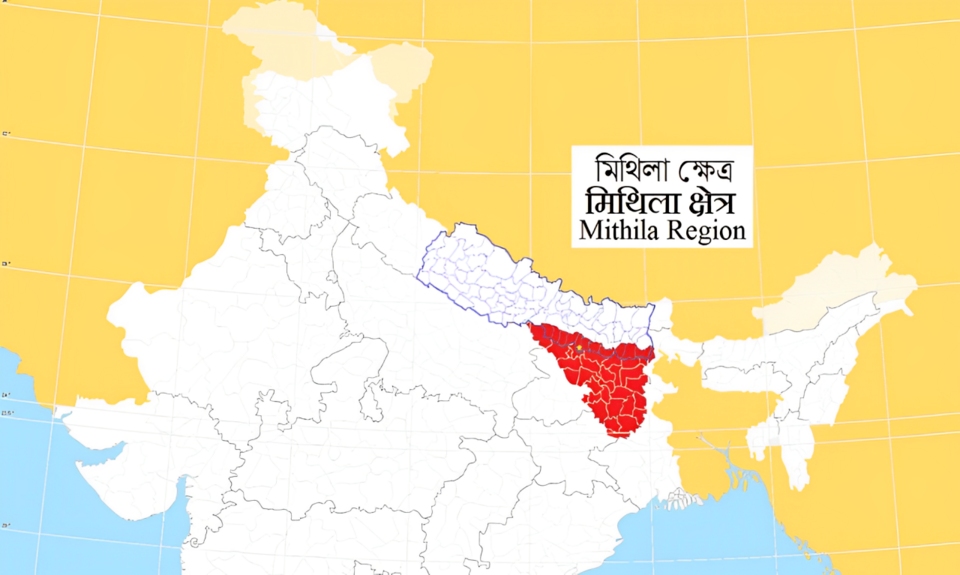
This period witnessed the rise of two influential powers that left a lasting imprint on both history and faith. On one side stood Kosala, with its capital at Ayodhya in present day Uttar Pradesh. On the other emerged Videha, centered in Mithila, or present day Janakpur, in what is now Nepal.
Videha was more than a political state; it became an important center of philosophy and learning. Its rulers, known as the Janakas, presided over courts where sages gathered to debate profound questions about Brahman and the nature of the Self. Historical accounts place this region at the heart of cultural and philosophical thought toward the end of the Vedic age. Many of the ideas later expressed in the Upanishads are believed to trace their intellectual roots to this land.
Ayodhya and Janakpur, each a center of power and culture in its own right, were destined to intersect.
The Sadanira River: A Boundary or a Bridge?
Vedic texts frequently mention a river called Sadanira, known today as the Gandaki River, which flows from Nepal into India. In ancient times, it marked the eastern frontier of Vedic expansion.
Geographically and spiritually, this river held great significance. It formed a natural boundary between Kosala and Videha, yet it never truly divided the people. Instead, it connected them through a shared sense of sanctity. The Gandaki has long been revered, and its stones, known as Shaligrams, remain sacred to this day.
This river witnessed civilization taking root in the Himalayan foothills. As Vedic communities crossed it into Videha, they helped lay the foundations of a shared culture. In this way, the Gandaki became not a line of separation but a living bridge between the two regions.
The Marriage of Ram and Sita: A Geopolitical Alliance?
At the intersection of history and belief stands the epic Ramayana. The marriage of Prince Ram of Kosala and Princess Sita of Videha was more than a personal union. It symbolized a powerful alliance between two of the most influential Janapadas of the time.
This union bridged the geographic distance between the two regions. The bond between Ayodhya in present day India and Janakpur in present day Nepal became a lasting foundation of cultural unity and kinship. It stands as a reminder that even thousands of years ago, a shared civilization flourished beyond what we now recognize as political borders.
In many ways, this marriage functioned like a geopolitical alliance that brought two kingdoms into a relationship resembling an extended family. Even today, when Vivah Panchami is celebrated in Janakpur, it feels as though the wedding procession has just arrived from Ayodhya.

Why Is This Ancient Route Back in Focus in 2025?
Returning to the present, a development in December 2025 has breathed new life into this ancient relationship. According to recent reports, the governments of India and Nepal have taken important steps to revive the historic Ram–Janaki Path.
This is not merely a road project. It is an effort to retrace the very route believed to have been traveled during the era of Ram and Sita. The initiative aims to improve connectivity between Ayodhya and Janakpur, making travel faster and more accessible. Work is also progressing rapidly on a new railway link that will directly connect these two historic capitals.
Journeys that once took weeks, and later only hours, are set to become even smoother. In this way, modern infrastructure is being built upon an ancient cultural foundation.
What Is the Ramayana Circuit and What Lies Ahead?
Official documents from India’s Ministry of Tourism describe the Ramayana Circuit as a flagship initiative. The project seeks to connect all places associated with the life of Lord Ram into a single, integrated network. The inclusion of Janakpur in Nepal highlights the fact that this circuit goes beyond national boundaries.
According to official data presented in Parliament around 15 December 2025, the initiative is expected to boost tourism while strengthening the deeply rooted “roti beti” relationship between India and Nepal. Budgetary provisions and infrastructure plans have already been outlined to support this effort.
In practical terms, this means that traveling to Janakpur may soon become as seamless as visiting any major Indian city. The initiative reinforces a simple truth: “heritage does not recognize lines drawn on maps.”
When viewed as a whole, the journey that began with the decline of the Indus Valley reveals a clear pattern. When rivers dried around 1900 BCE, people did not simply disappear, they moved. From the Gangetic plains to the Terai of Nepal, they created a living world whose legacy still endures.
The bond between Videha and Kosala, the sanctity of the Gandaki, and the union of Ram and Sita all point to the same conclusion: the border between India and Nepal has never truly been a barrier. Instead, it has acted like a seam, stitching two fabrics together into a stronger whole.
The roads and railway lines taking shape in 2025 are simply new arteries carrying the same ancient lifeblood. History reminds us that civilizations rarely vanish. They move, adapt, and in doing so often grow richer than before.
Sources:
https://tinyurl.com/28vjq7eq
https://tinyurl.com/2ybub7u9
https://tinyurl.com/2bm2wamx
https://tinyurl.com/24hy9kfy
https://tinyurl.com/2676z2az
https://tinyurl.com/232myk4f
https://tinyurl.com/2yq3vm5b