


Timelines 10
Man and his Senses 10
Man and his Inventions 10
Geography 10
Fauna 10
Timelines 10
Man and his Senses 10
Man and his Inventions 10
Geography 10
Fauna 10
Long before the bustling cities of the Indus Valley emerged, a quieter yet far more profound transformation was unfolding across mountains and plains. It marked a moment when human life itself began to change. Imagine a time when our ancestors chose to abandon the endless pursuit of animals for survival and instead settled in one place. Historians refer to this turning point as the Neolithic Age.
It was during this era that the first lasting cultural and social connections between what we now know as India and Nepal began to take shape. This journey leads us through the fertile plains of the Terai, where farming first took root, and into the valleys of Kathmandu, where stone tools reveal a story stretching from Kashmir to Assam, pointing to a vast and interconnected world.

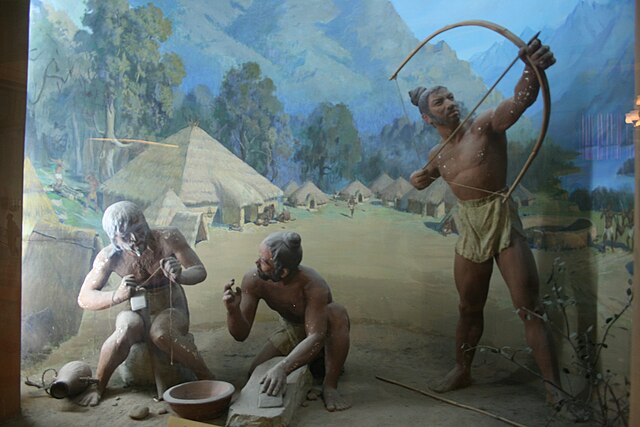
For thousands of years, human existence revolved around a single purpose: the search for food. People moved in small groups, hunting animals and gathering roots and fruits. Then came a shift that changed the course of human history forever, the Neolithic Revolution.
This was the moment when humans realized that seeds planted in the soil could grow into food, and that animals could be raised instead of hunted for survival. The impact was profound. Nomadic groups gradually began to settle. Farming required care and attention, which tied communities to one place, leading first to permanent homes and eventually to the formation of villages. The foundations of future civilizations were laid during this time.
This transformation did not occur suddenly. It unfolded gradually over thousands of years, reshaping society, the economy, and technology. The borderlands of present day India and Nepal emerged as some of the most important regions witnessing this sweeping change.
How Rice Cultivation in the Terai Reshaped Human Life?
Today, the Terai region that links India and Nepal is known for its vast stretches of rice fields. Yet few people realize that this agricultural landscape carries a history that goes back thousands of years. Archaeological evidence from Lahuradewa in Uttar Pradesh and nearby areas of the Terai in Nepal points to some of the earliest examples of rice cultivation.
For early farming communities, this fertile belt functioned almost like a living laboratory. Research suggests that people here began domesticating wild rice varieties, particularly proto Indica rice, a strain that developed within this very region. These discoveries show that the inhabitants of the Ganga plains and Nepal’s Terai were no longer relying solely on hunting. They were gradually building a more organized agricultural society.
Rice cultivation did more than simply provide food. It tied communities to the land and encouraged stability, creating a legacy that continues to shape the region even today.
What the Stone Tools of Lubhu Reveal?
The story now moves to Lubhu, a small settlement in the Kathmandu Valley that has become invaluable to archaeologists. Excavations here have uncovered Neolithic tools that reshaped our understanding of Nepal’s prehistoric past. Among the discoveries were finely polished stone axes and chisels, crafted with remarkable precision.
These tools reveal much about the skill of their makers. Their refined workmanship suggests a deep knowledge of stone shaping, far beyond the creation of simple survival tools. Lubhu’s importance goes beyond the artefacts themselves. It offers a glimpse into a society that had developed technique, planning, and a high level of craftsmanship.
Were Himalayan Communities Connected Thousands of Years Ago?
What makes the discoveries at Lubhu truly compelling is that they do not stand in isolation. When experts compared these tools with those found at Burzahom in Kashmir and Daojali Hading in Assam, striking similarities began to appear.
Burzahom, known for its Northern Neolithic culture, has yielded tools that are remarkably similar to those discovered in Nepal. The same patterns are visible in Assam’s Daojali Hading, where cord marked pottery and stone tools reflect techniques seen across other regions. Such consistency is unlikely to be accidental.
Instead, it points to sustained movement and exchange across the Himalayan region. From Kashmir through Nepal to Assam, communities appear to have used similar technologies while sharing ideas, skills, and knowledge. This was not a world of isolation; rather, it was an early cultural network that stretched across the subcontinent.
The 2026 Discovery in Dang Valley
A major breakthrough added a new dimension to this narrative on 7 January 2026, when researchers announced a significant discovery in the Tuhni Valley of Nepal’s Dang district. Excavations there revealed a large collection of Stone Age tools.
Reports suggest that this site was not simply a place where tools were found, but likely a center of tool production. The quantity and variety of implements indicate organized manufacturing, linking the Dang Valley with Lubhu and other known archaeological sites.
This discovery strengthens the view that different valleys across the Himalayan foothills served as hubs of tool making and possibly exchange. It reinforces the idea that this region, sheltered by the Himalayas, played an important role in the earliest stages of human civilization.
One Shared Courtyard, One Ancient Legacy
When these threads are woven together, rice cultivation in the Terai, stone tools from Lubhu and Dang, and technological parallels stretching from Kashmir to Assam, a clear picture begins to emerge. What we now recognize as the India–Nepal border once functioned as a shared cultural courtyard.
Our ancestors, whether hunters or early farmers, did not live in isolation. They exchanged seeds and stones, knowledge and techniques, laying the foundations for traditions that still echo in our food, customs, and ways of life. This history reminds us that the bond between India and Nepal is not defined by modern lines on a map, but by thousands of years of shared struggle, innovation, and human ingenuity.
Sources:
https://tinyurl.com/26cfvch6
https://tinyurl.com/27mprm8k
https://tinyurl.com/263uyo4v
https://tinyurl.com/2arkv9x2
https://tinyurl.com/2xlvs4ye
https://tinyurl.com/ydvw9dua
https://tinyurl.com/244u6ybb