


Timelines 10
Man and his Senses 10
Man and his Inventions 10
Geography 10
Fauna 10
Timelines 10
Man and his Senses 10
Man and his Inventions 10
Geography 10
Fauna 10
Can you imagine a time when the world’s highest peaks, the Himalayas, were submerged beneath a vast ocean? This is not a myth or a product of imagination, but one of the most remarkable truths about Earth’s history. Around 140 million years ago, the geography of our planet looked very different from what we see today. At that time, India formed part of a vast southern supercontinent known as Gondwanaland, located deep in the Southern Hemisphere.
What followed was a dramatic geological upheaval that permanently reshaped the face of the planet. This is the story of the moment when India broke away from its ancient landmass and began an extraordinary journey northward. During this movement, the Tethys Sea gradually disappeared, and a portion of the Earth’s crust was pushed upward, eventually giving rise to the landscape we now recognize as India and Nepal.
Why Did India Move North at Such Extraordinary Speed?
Around 140 million years ago, India was firmly embedded within Gondwanaland. It later broke away and began drifting northward in what was far from an ordinary continental migration. Scientists estimate that the Indian tectonic plate traveled nearly 9,000 kilometers over the course of 100 million years.
What makes this journey particularly remarkable is its speed. While most continental plates moved slowly and steadily, the Indian plate advanced northward at an astonishing rate of about 18 to 20 centimeters per year. Researchers believe that this unusual velocity was largely due to the structure of India’s lithosphere, the rocky outer layer of the Earth. At only about 100 kilometers thick, it was significantly thinner and therefore lighter than many other continental plates. This reduced weight allowed the Indian plate to move rapidly toward the Eurasian plate, continuing its relentless journey until the two finally collided.
How Did the Tethys Sea Rise to the Roof of the World?
Standing in the path of India’s relentless advance was the ancient Tethys Sea, a vast body of water that once separated India from Asia. When the Indian plate collided with the Eurasian plate around 50 million years ago, the impact was so powerful that it gradually closed the Tethys Sea and brought it to an end.
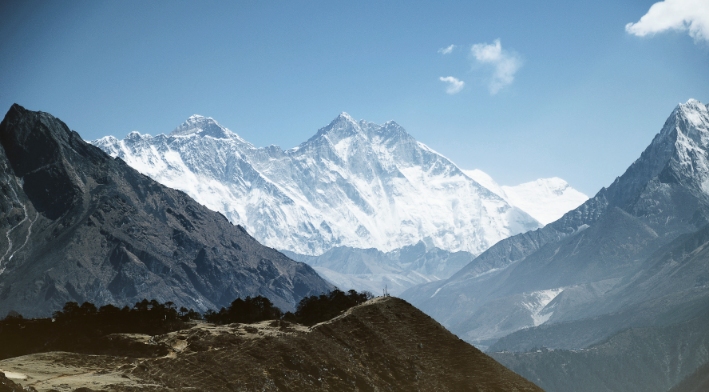
The collision compressed the Earth’s crust and forced it upward. Layers of seafloor sediments were folded and lifted, eventually giving rise to the highest mountain range on Earth, the Himalayas. This remarkable transformation explains why marine fossils can still be found at such extreme altitudes today.
Among the most striking examples are the Shaligram stones found in Nepal’s Kali Gandaki River. These stones are fossilized ammonites, marine creatures that once thrived in the Tethys Sea. Their presence high in the mountains offers compelling evidence that the peaks of India and Nepal were once part of the ocean floor.
Mountain building did not end with the rise of the Himalayas. As these towering ranges took shape, erosion began its quiet yet powerful work. Broken rock, debris, and sediment were gradually carried downhill by rivers and rainfall, collecting at the base of the mountains.
Over time, these deposits gave rise to the Shivalik Hills, known in Nepal as the Chure Range. They form the youngest and outermost ranges of the Himalayas, stretching from the Yamuna and Markanda river exit points in India to southern Nepal. Geological studies show that the Shivaliks are made of sediments eroded from the rising Himalayas themselves, forming a natural geological link that connects India and Nepal through a shared tectonic history.
Scientists continue to uncover clues preserved deep within Himalayan rock layers that date back to the Jurassic and Cretaceous periods. Studies conducted in India’s Spiti region and across Nepal’s Himalayan belt have revealed extensive deposits of ammonites and other marine fossils.
These remains mark the southern boundary of the ancient Tethys Sea. Whether discovered in Spiti or in the mountains of Nepal, the fossils tell the same story: this entire region once lay beneath the waters of a vast ocean. The land that now rises toward the sky is, in fact, the solidified memory of that ancient sea.

What Recent Research from January 2026 Reveals?
Recent findings released in January 2026 have added a new dimension to our understanding of Himalayan geology. Data presented at the American Geophysical Union meeting in San Francisco suggests that the Indian plate remains geologically active, though in a surprising and previously unrecognized way.
According to these findings, the Indian plate is fracturing beneath Tibet. Instead of breaking vertically, it appears to be peeling apart horizontally, much like layers of plywood separating from one another. Scientists refer to this process as delamination.
In this process, the upper portion of the plate continues to support the Tibetan Plateau, while the denser lower section breaks away and sinks into the Earth’s mantle. This discovery confirms that the formation of the Himalayas is not merely a completed chapter of the past, but an ongoing geological process that continues to shape the landscapes of India and Nepal.
The journey that began 140 million years ago is still unfolding. India’s rapid northward movement not only brought an end to the Tethys Sea but also gave rise to the highest mountains on Earth. The Shaligram fossils of Nepal and the marine remains preserved in India’s high altitude rocks stand as silent witnesses to a time when this land lay beneath the sea.
The Shivalik Hills and the continuing tectonic movements make one truth unmistakable: although India and Nepal may appear as separate nations on a political map, they rest upon the same immense slab of the Earth’s crust. Their mountains, rivers, and landscapes are the legacy of a single monumental collision that forever reshaped the face of the planet.
Sources:
https://tinyurl.com/29pna3fe
https://tinyurl.com/26yxtloz
https://tinyurl.com/28qpbnsa
https://tinyurl.com/292pejeg
https://tinyurl.com/29glet46
https://tinyurl.com/22tekrqd
https://tinyurl.com/2c2okp2e