


Timelines 10
Man and his Senses 10
Man and his Inventions 10
Geography 10
Fauna 10
Timelines 10
Man and his Senses 10
Man and his Inventions 10
Geography 10
Fauna 10
The Kathmandu Valley in Nepal is much more than a landscape of peaks and shrines. It stands as a profound testament to a historical era when art, architecture, and devotion merged to become the very essence of life. The period between 1200 and 1768, often hailed as the Malla era or the Golden Age, transformed this valley into a living gallery of the divine. Today, the masterpieces created during this time continue to tell their stories in the narrow alleys of Patan and Bhaktapur. However, this cultural revolution did not occur in isolation. Its roots reach back to the history of Eastern India, from where artists and monks traveled to help shape a new civilization in the lap of the Himalayas.
Did Indian artists help redefine the art of Nepal?
Historical records suggest that the artistic explosion in the Kathmandu Valley was no accident. Its origins stretched far into Eastern India. Toward the end of the 12th century, major centers of Buddhism and art in Eastern India, particularly under the Pala Empire, faced significant upheaval. Medieval invasions and political instability led to the decline of great monasteries and learning centers. During these trying times, many skilled monks, painters, and master craftsmen fled to the safety of the Himalayan hills to protect their lives and their legacy. These refugees did not just carry memories because they brought along precious manuscripts, sacred design manuals, and centuries of refined artistic techniques. In the fertile cultural soil of Nepal, these migrants planted the seeds of their heritage. A union took place between the Indian Pala style and local Newar traditions. This fusion gave birth to a civilization where temples, sculptures, and paintings were not merely decorative but were deep acts of spiritual devotion.
Is Paubha painting different from Tibetan Thangka?
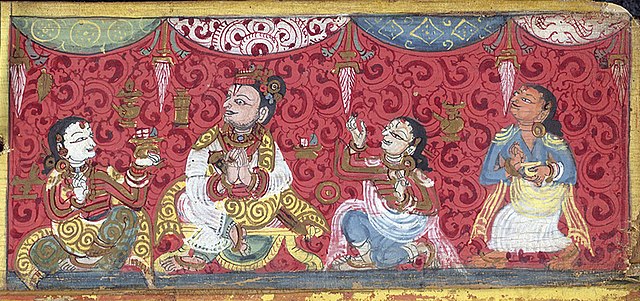
One of the most exquisite and sacred expressions of Newar art is the Paubha painting. This traditional scroll painting is at the heart of the cultural identity of the Kathmandu Valley. People often mistake it for the Tibetan Thangka, yet Paubha has its own distinct identity and history. Paubha is primarily based on religious themes and is used for meditation and prayer. Within these paintings, Hindu and Buddhist deities are depicted with immense detail and reverence. The style of Newar artists was so influential that it actually inspired Tibetan art. In fact, Paubha can be considered the ancestor of Tibetan Thangka art since it was the artists from Nepal who popularized this style of scroll painting in Tibet. The process of creating a Paubha is considered extremely complex and holy. From preparing the canvas to selecting colors, every step follows religious discipline. These paintings were not made simply to hang on a wall because they functioned as visual scriptures that taught the viewer about morality and the mysteries of the universe.
How was devotion carved into wood and stone?
The identity of the Kathmandu Valley is defined by its temples and palace squares, particularly in Patan and Bhaktapur. Architecture reached new heights under the rule of the Malla kings. During this era, the doors, windows, and the wooden struts supporting temple roofs were not just simple pieces of timber. They were transformed into intricate narrative panels. These carved woods featured myths, deities, and cosmic structures with such precision that they acted as scriptures made of wood and stone. The chisels of Newar craftsmen breathed life into lifeless material. Whether it was the entrance to a temple or a palace window, the fusion of art and religion is visible everywhere. These works reflect the significance of faith in the society of that time. During the Malla period, kings provided patronage to these artists, turning cities like Kathmandu, Patan, and Bhaktapur into architectural wonders.
What kind of partnership existed between Hinduism and Buddhism?
The most striking feature of this era was the amazing blend of Hindu and Buddhist symbols created by Newar artists. They mixed symbols from both religions so seamlessly that it is often difficult to distinguish which symbol belongs to which faith. In Newar art, the identities of various deities often merge into one another. This shows that instead of rigid religious divisions, a shared sacred imagination existed in the Kathmandu Valley at that time. One can find elements of Buddhist Tantra and Hindu mythology together in the same sculpture or painting. For example, Paubha paintings often depict tantric deities who are revered in both traditions. This is evidence of religious tolerance and cultural dialogue that made Nepalese art so rich and diverse. This artistic renaissance was not just a miracle but a regional partnership where Indian traditions and Nepalese innovation worked together.
What is the significance of this heritage in the modern world?
Paubha painting and Newar art remain alive today, even though they face the challenges of modern times. The style developed between 1200 and 1768 still defines the identity of the Kathmandu Valley. Paubha is sometimes seen as a fading world because the number of traditional artists is decreasing, but its religious and cultural importance has not diminished. These paintings and sculptures are still used in special religious festivals and rituals today. These artworks are not just museum pieces because they remain central to the faith of the people. This legacy of color composition, devotion, and craftsmanship developed by Newar artists leaves a lasting impact. It reminds us how art can transcend borders and religions to connect people. The dialogue between the early migrants from Eastern India and local Newar artists gave birth to a legacy that remains a pinnacle of color, devotion, and skill centuries later.
Sources:
https://tinyurl.com/22zc4s4v
https://tinyurl.com/2ahqfldt
https://tinyurl.com/2ym5cl8u
https://tinyurl.com/28yskq97
https://tinyurl.com/2amy5qdm
https://tinyurl.com/293ys4pt