


Timelines 10
Man and his Senses 10
Man and his Inventions 10
Geography 10
Fauna 10
Timelines 10
Man and his Senses 10
Man and his Inventions 10
Geography 10
Fauna 10
The sixteenth century brought a revolutionary shift that redefined the meaning of devotion. When the poet Tulsidas composed the Ramcharitmanas, the story of Lord Rama was no longer confined to temple walls or complex Sanskrit verses. It stepped out into the open air and became the voice of the common people. This transformation gave birth to Ramlila, a folk theater tradition that has bound India and Nepal together for centuries through faith, storytelling, and celebration. This article explores the magical journey that begins in the plains of North India and reaches the foothills of Nepal. We will see how a simple play dissolved borders and turned two nations into one cultural family.
How did the tradition of Ramlila begin and what is its form?
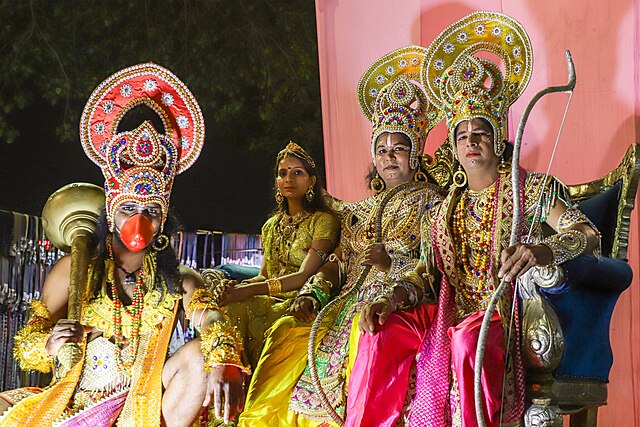
Ramlila is essentially a theatrical adaptation of the life of Lord Rama based on the epic Ramcharitmanas. According to official UNESCO documents, this tradition is primarily observed in North India, especially in places like Ayodhya, Ramnagar, Varanasi, Vrindavan, Almora, Sattna, and Madhubani. These performances are not merely for entertainment because they are a rhythmic blend of songs, dialogues, and storytelling. During the festival of Dussehra, the entire community participates in this celebration which lasts for ten to twelve days or sometimes an entire month. The most remarkable aspect is that Ramlila erases distinctions of caste, religion, or age. Ordinary villagers become the performers while the audience watches with such devotion that they feel like true witnesses to a divine event.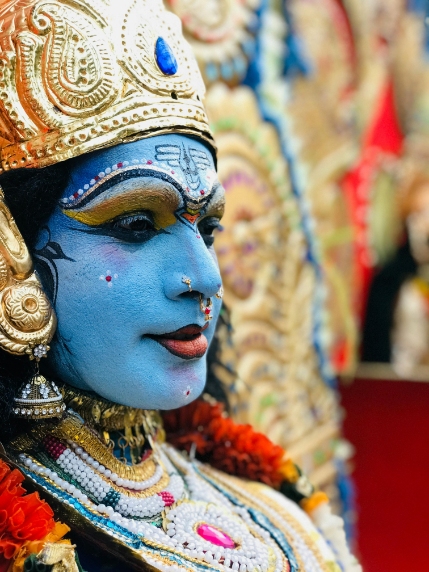
Why is the Ramlila of Ramnagar considered the most unique performance in the world?
When discussing Ramlila, the performance at Ramnagar near Varanasi holds a special place. It does not take place on an ordinary stage because the entire town of Ramnagar becomes a massive set. This event lasts for thirty one days and was initiated in the nineteenth century by the King of Kashi, Udit Narayan Singh. The grandeur of this performance is evident from the fact that no modern electric lights are used. Even today, kerosene lamps and torches illuminate the scenes to create an ancient and mystical atmosphere. The King of Kashi arrives on his elephant every evening to witness the play, which adds a sense of royal dignity to the spiritual experience. The audience does not sit in one place but instead moves along with the actors to different parts of the city as if they are also part of the exile or the great war.
How did the echoes of Ramlila reach the land of Nepal?
The story of Lord Rama does not stop at the borders of India. It resonates deeply in Janakpur, Nepal, which is believed to be the birthplace of Mother Sita. According to the Nepal Tourism Board, Janakpurdham is not just a historical city but a major center of Hindu faith. The Janaki Temple located here is a stunning example of Mughal and Rajput architecture and serves as a symbol of this shared culture. Traditions related to Ramlila and the Ramayana are not limited to theater in Janakpur because they are woven into the daily lives of the people. Reliving the memories of an ancient era, devotees celebrate the marriage of Rama and Sita every year. This city stands as proof that regardless of political boundaries, the cultural relationship between India and Nepal is one of deep family ties and unbreakable faith.
How do Janakpur and Ayodhya unite during the festival of Vivaha Panchami?
Every year, a magnificent sight unfolds in Janakpur on the fifth day of the bright half of the lunar month of Margashirsha. This day is known as Vivaha Panchami. It is celebrated as the wedding anniversary of Lord Rama and Sita. On this occasion, the distance between Ayodhya in India and Janakpur in Nepal seems to vanish. Millions of pilgrims gather to be part of this sacred day. Rituals such as the hoisting of the flag are performed to symbolize deep spiritual unity. This day is more than just a festival because it marks the union of two ancient cities, Ayodhya being the city of Rama and Janakpur being the city of Sita, where traditions thousands of years old come back to life.
How are the wedding rituals and the marriage procession welcomed?
The celebration of Vivaha Panchami in Janakpur is conducted exactly like a real wedding, complete with traditional rituals, songs, and a surge of emotions. During this time, the marriage of Rama and Sita is reenacted with great detail. A symbolic marriage procession travels from Ayodhya to Janakpur and is welcomed with immense enthusiasm by local residents and pilgrims. Several traditional ceremonies are performed during the week long event, including the Tilak ceremony, the Matkor ritual, and the Swayamvar. The Matkor ritual involves the tradition of digging soil, which is an essential part of wedding preparations. During the Swayamvar, the scene where Lord Rama broke the bow of Shiva is brought to life. Watching these rituals, devotees feel as though they have returned to a divine era and are witnessing the holy wedding themselves.
Why does this tradition matter to us in the modern world?
In an era where the world is racing toward modernization, festivals like Ramlila and Vivaha Panchami keep us connected to our roots. According to the UNESCO Silk Road Project, Ramlila is performed in various forms across North India during Dussehra. The mix of songs, stories, and dialogues has kept it relevant for centuries. It is not just a religious ritual because it serves as a powerful medium to convey the message of the victory of good over evil. From Janakpur to Ayodhya and from the riverbanks of Varanasi to the Himalayan foothills, Ramlila proves that while languages and geography may differ, the story of Rama and the sacrifice of Sita still echo as a shared heartbeat in the hearts of millions.
Sources:
https://tinyurl.com/255wgsuf
https://tinyurl.com/2yqycfgs
https://tinyurl.com/23nywhj4
https://tinyurl.com/25uj6eg9
https://tinyurl.com/ycq3seyr