


Timelines 10
Man and his Senses 10
Man and his Inventions 10
Geography 10
Fauna 10
Timelines 10
Man and his Senses 10
Man and his Inventions 10
Geography 10
Fauna 10
In the mid nineteenth century, as the worlds of science and art were filled with new experiments, one invention forever changed how history was recorded. This invention was the camera. Between 1850 and 1900, a dramatic shift occurred in the mountains of North India and Nepal. This change was not brought about by cannons or swords but by heavy wooden boxes filled with glass plates and chemicals. Before this time, the image of the Himalayas was limited to paintings or travel journals, but the arrival of photography showed the world a new and authentic face of these mountains and the people living there. This article tells the story of an era when British travelers like Samuel Bourne captured inaccessible peaks through their lenses and Indian artists like Raja Lala Deen Dayal created history on their own terms. It is also the tale of the forbidden valley of Nepal, where rulers turned this new technology into a symbol of their power.
How did Samuel Bourne bring the remote Himalayan peaks to the world?
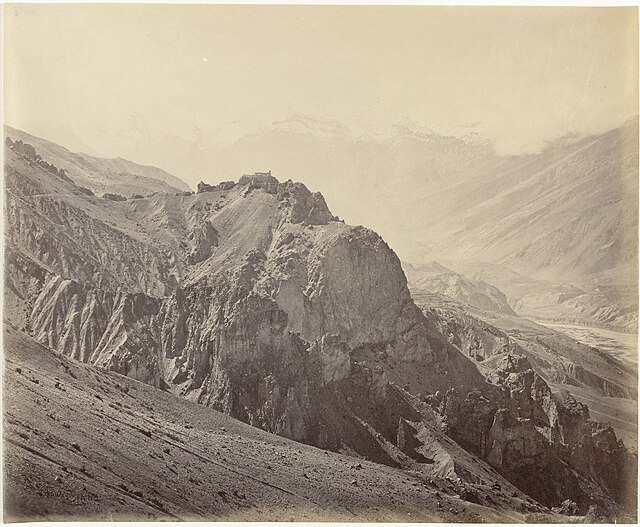
When we look at old black and white photographs of the Himalayas showing snow covered peaks and deep valleys, we often forget the hard work behind them. British photographer Samuel Bourne, who arrived in India in 1863, accomplished this feat. At that time, photography was not as easy as it is today. It was the era of the wet plate collodion process, which required heavy glass plates, chemicals, and a portable darkroom tent. Bourne made three major and dangerous journeys into the Himalayas with this bulky equipment. He even traveled to and photographed the Manirung Pass at an elevation of 18,600 feet. His photographs gave people in Britain and Europe their first true sense of the grandeur of the Himalayas. For them, the mountains were not just rocks but a picturesque world waiting to be explored and conquered.
Did Bourne and Shepherd provide a new lens to view India?
Samuel Bourne partnered with Charles Shepherd to establish the Bourne and Shepherd studio in Shimla and Calcutta. It became one of the oldest photography studios in the world. This studio captured more than just mountains because it documented the architecture, landscapes, and daily life of all of North India. Their photographs were not just memories but became documents of the expansion and power of the British Raj. They presented India as a mysterious and beautiful country that was a source of pride for colonial rulers. These images created a specific vision of India in the Western world that lasted for many decades. In these photos, India was often shown as an untouched and vast territory that served as a perfect backdrop for the exploration and administration of the British Empire.
How did Lala Deen Dayal present an Indian perspective in photography?
While foreign photographers like Samuel Bourne were looking at India from an outside perspective, an Indian artist turned the camera into his own tool. This was Raja Lala Deen Dayal. He began his photography career in the mid 1870s and quickly became the most famous Indian photographer of his time. He was appointed as a photographer for the Nizam of Hyderabad and later for Queen Victoria. Deen Dayal did not just take pictures of buildings because he captured the lives of Indian kings, nobles, and their royal courts with great intimacy. His work possessed a sense of dignity and familiarity that was often missing from the work of foreign photographers. He showed that Indian society was not just a land of snake charmers or ruins but home to a rich and modernizing culture.
What was the role of Indian photographers in royal courts?
The work of photographers like Lala Deen Dayal was not just about taking pictures because they were preserving history within an Indian context. There is a clear difference between the work of indigenous photographers and colonial ones. While British photographers often portrayed India as a subordinate or exotic land, Indian photographers depicted their patrons such as kings and emperors with power and authority. In the portraits by Lala Deen Dayal, the Indian elite appear full of confidence. He also used his camera to capture harsh realities like famines and relief efforts, which reflects the social concerns of that era. In this way, he changed the language of photography and made it a medium for self expression and self respect.
Who took the first photographs of the forbidden valley of Nepal?
While photography was spreading rapidly in India, Nepal remained almost entirely closed to the outside world. Very few foreigners were allowed to enter the Kathmandu Valley. This raises the question of who took the first photographs of Nepal and how. Between 1863 and 1865, Clarence Comyn Taylor, the Assistant Resident at the British Residency in Kathmandu, took some of the earliest images of the country. Since professional photographers could not enter Nepal, the responsibility fell on the shoulders of amateur British officials like Taylor. He captured the temples of Kathmandu, Newar architecture, and the local people. These photographs are priceless today because they are the only visual testimony of a time when Nepal was hidden from the eyes of the world.
How did these early photos give a voice to ordinary people?
Looking deeply at these early photographs reveals that the motive was not just to capture beauty. These images were often part of a larger ethnographic project aimed at classifying and understanding different castes and communities. In these photos from the 1860s, we see ordinary Nepali citizens such as farmers, soldiers, and Newar women for the first time. Before this, the history of Nepal existed only in written documents or religious paintings. Photography gave the common man a place in the pages of history for the first time. These images tell us what people looked like, what they wore, and what their surroundings were like. This marked the beginning of the visual history of Nepal.
How did the Rana rulers turn photography into a symbol of prestige?
Although photography entered Nepal through foreigners, the ruling class known as the Ranas adopted it very quickly. Jung Bahadur Rana recognized the power of photography during his visit to Europe. Soon, the practice of photography began in the courts of Kathmandu. The Rana rulers did not just have formal portraits taken because they also appointed special photographers in their courts. These photographs followed the style of Indian royal families with elaborate clothing, serious poses, and grand backgrounds. For the Ranas, photography was not just a hobby but a way to display their modernity and sovereignty. They used it to strengthen their political legitimacy and present themselves as powerful rulers.
How do photographs shape our political memory?
When we look at these old photographs today, we must realize they are not just scraps of old paper. These early photographic archives play a vital role in shaping political imagination and memory. In the context of Nepal and India, these images are keys to understanding the politics, power balance, and social structure of that era. They tell us how history was written or presented. Whether it was the Himalayan views of Bourne or the portraits of the Ranas, every photograph had a purpose. Today, these images are an important resource for researchers and historians as they help us understand how people in the past saw themselves and their world.
Sources:
https://tinyurl.com/262f6jsn
https://tinyurl.com/25sncn62
https://tinyurl.com/2y3cefz4
https://tinyurl.com/222ohn7o
https://tinyurl.com/2dpww82j
https://tinyurl.com/227kf4b8
https://tinyurl.com/2xhf6mfo
https://tinyurl.com/2xjjeq2v