


Timelines 10
Man and his Senses 10
Man and his Inventions 10
Geography 10
Fauna 10
Timelines 10
Man and his Senses 10
Man and his Inventions 10
Geography 10
Fauna 10
Between the 15th and 17th centuries, a spiritual wave known as the Bhakti movement swept through North India and Nepal. It did more than just redefine faith; it transformed music forever. This was not merely a new way to worship but a musical revolution that wove an invisible thread between the Himalayan peaks and the vast plains of the Ganges. Today, as we discuss modern sounds, we often overlook the roots that grew simultaneously in the temples of Kathmandu and the riverfronts of Varanasi. This article explores an era when saints like Kabir rejected rigid rituals and the songs of Vidyapati traveled from the heart of Mithila to the royal palaces of Nepal. We will also see how this shared heritage still echoes in sacred sites like Lumbini.
How did the Bhakti movement turn music into a medium of worship?
During the Middle Ages, when society was tangled in religious complexities, Kabir and other saints offered a different path. They believed that reaching the divine required sincere love and surrender rather than complicated ceremonies. Music became the most powerful way to express this devotion. Kabir, a weaver from Varanasi, preached the concept of a formless God. According to reports from the Himalayan Academy, Kabir used music to reach the masses. His compositions were meant to be sung rather than just read. He used local dialects like Khari Boli that common people understood. In his verses, he used metaphors like the loom and the cloth which reflected his trade but carried deep spiritual meaning. Through music, he broke the barriers of caste and religion to speak directly to the human heart. His couplets remain a core part of North Indian classical and folk music today.
How did Kirtan and Bhajan become part of a mass movement?
The greatest contribution of the Bhakti movement is the tradition of Kirtan and Bhajan. Starting as early as the sixth century, this movement emphasized a personal relationship with the divine. The word Kirtan comes from the Sanskrit root meaning to praise, while Bhajan means to share or serve. In North India, Kirtan is often seen as a group chant, while in the South, it is known as Bhajan. This music was not restricted to temples but became a part of daily life. It did not require trained musicians because anyone could participate. This was a democratic form of music. Devotees praised their chosen deities, such as Ram, Krishna, or Shiva, using simple melodies. Ancient scriptures like the Bhagavad Gita also describe this musical path as a means to liberation. In this way, music created a sense of social harmony where people from all backgrounds of life could sit and sing together.
Who was Vidyapati, the bridge between India and Nepal?
Vidyapati, the great poet of Mithila, played the most significant role in the cultural exchange between North India and Nepal. Known as the Cuckoo of Mithila, he was a poet, musician, and statesman. He was born into a learned family that served the kings of the Karnat dynasty for generations. While North India faced political shifts, Mithila preserved its cultural identity. Vidyapati chose to compose in his mother tongue, Maithili, rather than Sanskrit. His songs about the love of Radha and Krishna and human emotions became instantly popular. Remarkably, his influence extended far beyond Bihar. The Malla kings of Nepal adopted his works into their courts and temples. Maithili plays and songs began to be performed in the royal courts of Nepal. Scholars and artists frequently traveled between Mithila and Nepal, creating a shared cultural zone. Vidyapati’s songs remain a vital part of Nepali folk and classical culture today.
How did Dapha music emerge in Kathmandu?
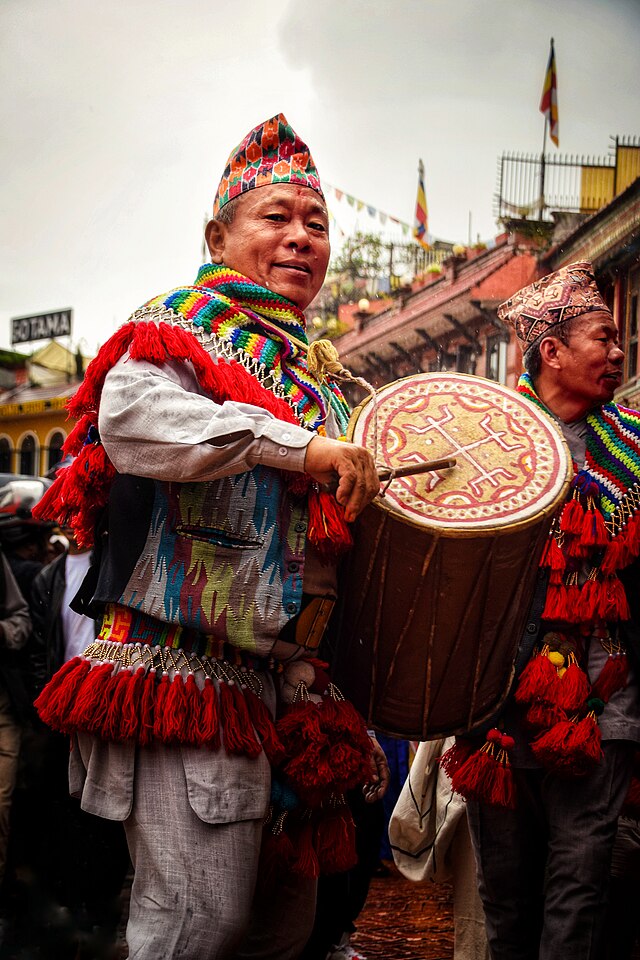
As the wave of devotional music moved north, it took a unique shape in the Kathmandu Valley of Nepal. This is known as Dapha music. Dapha is a devotional form practiced by the Newari community, which flourished in the 17th century under the Malla kings. The city of Bhaktapur, once the capital, remains the heart of this tradition. Dapha music is special because it combines written manuscripts, oral traditions, and live performance. The Malla kings were great patrons of the arts. They welcomed musicians and scholars from India, which allowed Indian ragas and rhythms to blend with local Nepali traditions. Groups perform Dapha music in temple courtyards as a form of service to God rather than mere entertainment. Just as Varanasi has its Dhrupad tradition, Dapha music in Kathmandu took on a classical form based on disciplined scales and cycles.
Does Nepal also follow the Guru Shishya tradition of learning?
Similar to Indian classical music, the Dapha music of Nepal follows a highly organized system of teaching. Research papers indicate that Newari communities provide training through the traditional teacher and student relationship. The place of learning is called the Akh Chhe, or the music house. Training begins with a prayer to the god of music. Senior musicians known as the masters of singing and the masters of percussion train the new generation. This education is entirely oral, where students learn by observing and listening to their teachers. Discipline is very important in this setting. Every person in a Dapha group has a specific role. This tradition keeps the music alive while passing social and religious values from one generation to the next. This system is identical to the traditional musical lineages found in India, proving that the musical soul of both countries is the same.
How did Bhakti saints reshape music during the Mughal era?
The journey of music reached beyond temples into the Mughal courts. Historical records suggest that Mughal emperors, particularly Akbar, were deeply drawn to Bhakti saints. During this time, saints used music to present their social ideals and devotion, which helped bring Hindu and Muslim communities closer. Leaders like Vallabhacharya promoted Haveli Sangeet, where devotional songs were performed for Lord Krishna within temples. Poets like Surdas and Kumbhandas created a blend of music and poetry that later became the foundation of Hindustani classical music. They developed styles like Dhrupad and Dhamar. This was an era where the lines between courtly and devotional music began to fade. The same music sung in temples for worship began to be appreciated in courts as high art. Thus, the Bhakti saints provided the structure for the North Indian music we hear today.
Where does this shared heritage stand today?
This centuries old cultural partnership is still thriving and finding new platforms. Reports from the Kathmandu Post mention that the third India Nepal Cultural Festival took place in Lumbini in December 2025. Organized by the Indian Embassy and the Lumbini Development Trust, the festival celebrated the shared legacy of both nations. The event featured Odissi dance and performances by the traditional Nepali band Ghugu Mugu, showing that the language of art still connects the two countries. Scholars at a seminar in Lumbini Buddhist University discussed how Buddhist and Hindu traditions are deeply entwined. This festival was more than just an event; it served as a reminder that even though political borders exist, the hearts of India and Nepal beat to the same rhythm through music and culture.
Sources:
https://tinyurl.com/2bbkhrcy
https://tinyurl.com/2767e57l
https://tinyurl.com/28kcjogw
https://tinyurl.com/23xmtjn3
https://tinyurl.com/29coufjm
https://tinyurl.com/29dd4ond