



Timelines 10
Man and his Senses 10
Man and his Inventions 10
Geography 10
Fauna 10
Timelines 10
Man and his Senses 10
Man and his Inventions 10
Geography 10
Fauna 10
In the high and rugged mountains of the Himalayas, a house is not merely a lifeless structure made of bricks and stones. Instead, it is a living entity that breathes alongside these peaks. Understanding the soul of the shared architecture between the mountainous regions of India and Nepal reveals that the ancient builders of both nations mastered the art of surviving in extreme conditions. A very deep and surprising shared secret lies between the famous Kath Kuni architecture of Himachal Pradesh in India and the renowned pagoda temples of Kathmandu in Nepal. This secret is the technique of special wood weaving known as timber lacing. In stark contrast to modern science, these ancient buildings absolutely do not use rigid and stiff concrete to fight earthquakes. Instead, these structures built with timber lacing and masonry are designed in such a way that they can easily dance with the violent shocks of an earthquake when the ground shakes. The interlocking wooden joints used in them act like natural shock absorbers. This is the major scientific reason why these centuries old traditional Himalayan buildings easily withstand the most massive earthquakes and avoid turning into rubble.
Why are the central courtyards called the lungs of a house?
Beyond earthquake protection, the interiors of these traditional homes are nothing short of a miracle. When we step into the cool and shady courtyards of these houses, it feels like an entirely different world. These open courtyards are known as Havelis in traditional Indian architecture and Bahals in the unique Newar architecture of Nepal. These are not just empty spaces left inside the house. In reality, they act like the lungs of any home, helping the entire structure to breathe. According to a UNESCO report, these courtyards hold special and historical significance in the urban design and Newar architecture of the Kathmandu Valley. These courtyards are built using a scientific method that traps cool air inside the house during the summer season and retains the warmth of the sun during the freezing cold of winter. This centuries old design forces us to realize that modern air conditioning is merely a contemporary luxury, whereas in the past, building a climate responsive home without electricity was a common and essential way of life.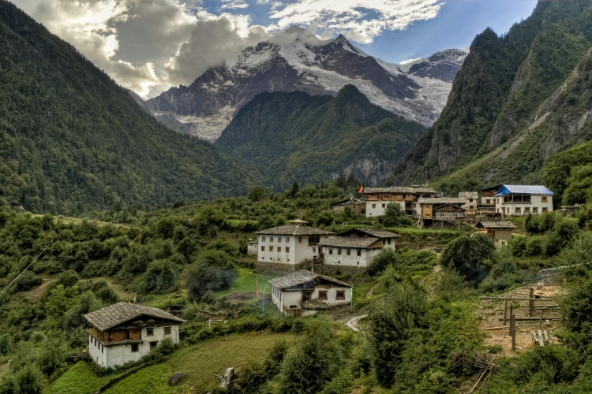
How do sloped roofs tie the entire Himalayas together?
Along with this scientific understanding of courtyards, another highly crucial part of Himalayan architecture is its roofs. From the beautiful valleys of Kashmir in India to the lush green hills of Pokhara in Nepal, the sloped roofs of houses symbolize a deep brotherhood and shared understanding. Designed to suit the diverse climates of the plains, hills, and high mountain regions, these Nepali and Indian homes are always ready to endure every strike of the weather. The roofs of these houses are built with a specific slope and utilize heavy slate stones and wooden tiles. The biggest and most direct benefit of this special design is that heavy monsoon rainwater and excessive winter snow slide down easily without damaging the roof. This is such an excellent and natural method of climate adaptation that makes the harsh mountain life safe and comfortable without the need for any modern machines.
Why is the growing encroachment of concrete a new crisis for the mountains?
Today we are facing a highly dangerous modern crisis that can be called the encroachment of concrete. Ugly boxes of cement and concrete with flat roofs have now begun replacing these sensible, climate responsive homes that have existed in the mountains for centuries. In the blind race for modernity and development, people are abandoning traditional methods, considering them backward. However, scientific data tells a completely different and highly terrifying truth. Authentic research shows that compared to modern concrete houses, homes made from traditional and local building materials remain naturally one to two degrees cooler in summer. Furthermore, a deep analysis of post earthquake reconstruction work makes it clear that these new cement homes are much colder, more uncomfortable, and more unsafe to live in than traditional architecture. These stiff concrete structures are entirely opposite to the mountain weather and the unstable nature of the ground there, which has made them a massive threat to both the safety and health of the residents.
Does true stability lie in modern glass or ancestral wood and stone?
We have witnessed the most terrifying and painful form of this concrete failure during the devastating earthquakes that have occurred in recent years. Academic reports following the recent earthquakes in western Nepal strongly emphasize that modern concrete structures proved to be complete failures when the ground shook and collapsed like a house of cards. These major disasters have exposed the hollow claims of modern engineering. On the contrary, the buildings constructed with traditional earthquake resistant architecture stood perfectly strong even amidst these violent tremors. This is the main reason why serious efforts are now being made to revive these traditional architectural styles in western Nepal and other parts of the Himalayas. After observing all these scientific and ground realities, we reach the clear conclusion that true sustainability in the Himalayas absolutely does not mean looking toward the gleaming steel and glass of the future. Instead, true wisdom and safety lie in returning to that profound ancestral knowledge of wood and stone that has preserved human existence in these beautiful and formidable Himalayas for thousands of years.
Sources:
https://tinyurl.com/28jaj74w
https://tinyurl.com/2ylekblb
https://tinyurl.com/285hsnuk
https://tinyurl.com/26c5gtgf
https://tinyurl.com/2y7rerov
https://tinyurl.com/26gk9fhg
https://tinyurl.com/2a6ecmcn