


Timelines 10
Man and his Senses 10
Man and his Inventions 10
Geography 10
Fauna 10
Timelines 10
Man and his Senses 10
Man and his Inventions 10
Geography 10
Fauna 10
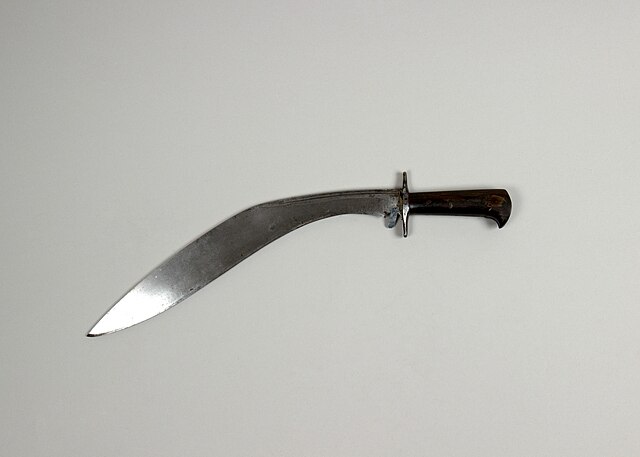
The Khukuri is not just an ordinary piece of iron or steel. It is the immortal soul of a chivalrous tradition that binds India and Nepal in an unbreakable thread. Very deep and shared military roots exist between these two nations, with a history spanning centuries. This historical journey began when incredibly courageous Rajput warriors migrated and made their new home in the rugged and mysterious hills of Gorkha. Moving away from their motherland, these warriors did not just take their families. They also carried with them the art of war, profound knowledge of weaponry, and an unyielding self respect. Along with these warriors, the science of weapons also traveled from the plains to the high mountains. Academic and historical research clearly confirms that the straight sword used in ancient India, known as the Khanda, evolved over time according to the geographical and strategic needs of the Himalayas. To fight battles in the narrow paths and dense forests of the mountains, a weapon was needed that was swift and accurate in its strike. The straight Khanda gradually transformed into a highly fearsome and curved weapon that the whole world today knows as the Khukuri. A deep historical connection regarding its design is also linked to the ancient Greek weapon Kopis, which further explains its striking power, balance, and scientific intricacies. This curved blade did not remain limited only to the battlefield. It became the undisputed identity of an entire civilization, a whole community, and a shared heritage.
Is the Khukuri merely a weapon or the soul of an entire civilization?
In the shared spiritual culture of India and Nepal, weapons are not considered merely tools for bloodshed or the destruction of enemies. Instead, they are revered as godlike protectors and worshipped with elaborate rituals. The grandest and most sacred form of this cultural and religious connection is seen during the great festival of Dussehra. On this holy occasion, everyone from ordinary citizens to soldiers stationed at the border bows before their weapons and worships them as divine protectors. This sacred and ancient worship of weapons is known as Khanda Puja. In this unique tradition, a remarkable confluence of weaponry and scripture is seen, along with war and spiritual detachment. Here, a warrior bows to his weapon and takes a solemn pledge that it will be used solely for righteousness and protection. The task of preserving the historical grandeur, design, and cultural significance of these weapons is still being done with great responsibility and pride today by the national museums in New Delhi and Kathmandu. The historical weapons displayed in the galleries of the National Museum in New Delhi are living proof of that shared craftsmanship, metallurgy, and artistry of the Mughal and Rajput eras, which continuously evolved over time and reached the beautiful valleys of Nepal. These massive museums are not just storehouses for old and rusty objects. They are the resting places of those silent protectors whose sharp edges determined the direction of the history of the entire subcontinent.
Is this ancient chivalrous identity alive even in modern society and military structures?
The extremely clear and glorious answer to this question is found in the social fabric of the northeastern states of India and the invincible Gorkha Regiment of the Indian Army. The Gorkha community settled in various parts of Northeast India still proudly embraces this chivalrous and martial identity close to its heart today. Deep sociological studies on this subject reveal that this community living in the Northeast is not just a group with a military background. Instead, it acts like a highly responsible and strong bridge connecting the social and cultural gap between India and Nepal. The indomitable history of Gorkha soldiers in the Indian Army is centuries old, and this blood relation stands today with full grandeur and loyalty. Historical documents from the National Army Museum also officially confirm that Gorkha soldiers have had a very old, deep, and unbreakable relationship with the Indian military system. When these brave soldiers, who display unmatched courage on the terrifying battlefield, stand firmly on the frontlines with their gleaming Khukuri, they are not just protecting the geographical borders of one country. Rather, they are protecting that entire shared and great heritage which the ancestors of both countries forged together centuries ago.
Is modern military diplomacy strengthening this traditional defense cooperation even more?
Stepping out of the pages of ancient history, this shared chivalrous heritage has today become the main foundation of modern military diplomacy and strategic partnership. The joint military exercise named Surya Kiran, successfully concluded in December 2025, is the freshest, most relevant, and living symbol of this. In this military exercise, the brave soldiers of both neighboring countries take rigorous and modern military training shoulder to shoulder on the same field. According to detailed analyses by strategic defense experts and prestigious think tanks, this modern and advanced defense cooperation between the two countries is not merely a paper or diplomatic formality. Rather, it stands proudly on a very strong foundation of the same shared military history and the deep cultural ties of the invincible Gorkha Regiment. Comprehensive military exercises like Surya Kiran prove to the world that old chivalrous traditions have given a new direction and an unerring edge to modern tactical, technical, and strategic military relations. When the armies of both countries sweat together, it is not just a display of combat skills. It is a profound brotherhood that has passed every difficult test of time and has emerged even stronger with every new challenge.
Does modern law manage to strike a balance between this cultural right and security?
In today's modern and democratic era, the biggest challenge facing a highly lethal and traditional weapon like the Khukuri is that of law, peace, and order. On one side is centuries old faith, and on the other is the question of public safety. The Arms Act of India handles this extremely delicate and sensitive issue with great maturity, understanding, and legal nuance. The detailed and official document of the Indian Arms Rules 1962 clearly establishes an excellent and ideal balance between minority cultural rights and broader public safety. Under this important law, a special legal exemption has been granted to the Gorkha community so that they can proudly carry this ancestral, historical, and sacred weapon with them. This special legal provision is the biggest proof that the modern nation state and its policymakers also fully understand and completely respect the cultural depth and historical significance of this weapon. Ultimately, it is incredibly important to understand that the Khukuri is absolutely not merely a symbol of violence or war. Instead, it is a symbol of supreme honor, unbreakable self respect, a distinct identity, and a historical brotherhood that has united the people of India and Nepal forever.
Sources:
https://tinyurl.com/23dwlkjn
https://tinyurl.com/283onopo
https://tinyurl.com/24dptnbq
https://tinyurl.com/2yb622gt
https://tinyurl.com/2xqnztv4
https://tinyurl.com/294m3ag3