


Timelines 10
Man and his Senses 10
Man and his Inventions 10
Geography 10
Fauna 10
Timelines 10
Man and his Senses 10
Man and his Inventions 10
Geography 10
Fauna 10
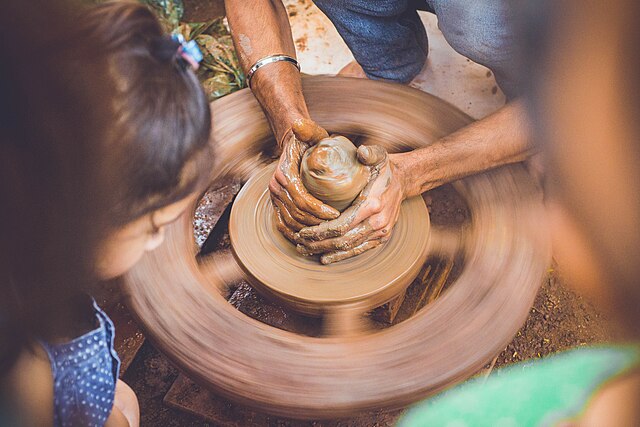
The fertile borders of the Terai region, situated between the plains of India and the foothills of Nepal, are not merely a geographical line. This is the land where the soil itself tells a profound story of cultural unity. Here, a simple lump of clay becomes a sacred object in both nations. Looking at history, the roots of pottery in Nepal and India are over five thousand years old, with traces reaching all the way back to the ancient Indus Valley Civilization. The Lumbini zone in the western Terai region is a significant treasure trove for archaeologists. This area is home to Lumbini, the birthplace of Lord Buddha, as well as Kapilavastu, the capital of the Shakyas, and Ramgram, the maternal home of Buddha. Excavations here have completely proven that in ancient times, this region had deep cultural and trade connections with places in northern India like Piprahwa and Ganwaria. The terracotta figures of humans and animals, ancient seals, coins, and stone sculptures found during these excavations make it clear that pottery making traditions have been shared across the border for millennia. The soil of the Kathmandu Valley in Nepal is incredibly fertile and perfectly suited for pottery, allowing this art to reach its artistic peak during the Malla period between the twelfth and eighteenth centuries. Even today, the hand-molded and finely carved red clay water pots of the Thimi area, along with the unique black pottery of Bhaktapur baked in closed oxygen deprived kilns, stand as living proof of this shared historical heritage.
The relationship between clay and humans is not just about utility. It is deeply rooted in faith and the cycle of life. In Hinduism, human life is considered a path to attaining the divine, and sixteen major life rituals are prescribed from conception to marriage. The use of clay pots is considered absolutely essential in all these important rituals. At the time of birth, a newborn child's umbilical cord is placed in a clay pot and buried in the ground. During the sacred thread ceremony, when the Gayatri mantra is chanted and the fire element is invoked, a clay pot is used to establish the central deity. The marriage ceremony is completely unfinished without it. When a bride enters her new home, the worship of local deities is completed using clay pots. Traditions during marriage like looking at the Pole Star to symbolize eternity, looking at the Arundhati star for purity, and observing the Saptarishi to honor the debt to ancient sages are all deeply connected to the purity of clay. Furthermore, donating bamboo baskets is a custom meant to bless the growth of the family lineage. Moving beyond birth and marriage, humanity relies on this exact same clay pot to carry the sacred fire to the cremation ground during the final truth of life, which is death.
What role does clay play in the human connection with nature?
Moving beyond personal life rituals, if we talk about folk festivals, grand celebrations like Chhath Puja observed in Bihar in India and the Kathmandu Valley in Nepal simply cannot be completed without clay pots. During this festival, bamboo baskets and clay pots are exclusively used to offer sacred water to the Sun God. Long before modern global debates on environmental conservation and sustainability began, Chhath Puja taught the world the principle of living in perfect harmony with nature. When devotees stand in flowing water to worship the rising and setting sun, they hold clay pots in their hands. This clay vessel is not an ordinary object. It is the result of generations of craftsmanship and wisdom that holds water and connects our prayers directly to the Earth. Created from various elements of nature, this vessel delivers a vital message that the materials used in worship ultimately return to the Earth through the very same cycle from which they were formed. The ritual of standing in water to absorb the energy of the sun also acts as a natural therapy that relieves modern stress, anxiety, and social isolation. The entire community comes together to prepare a traditional wheat offering called Thekua, which serves as a brilliant example of uniting society.
What challenges does this centuries old art face today?
Even though the spiritual significance of pottery is incredibly deep, the hands that shape this clay are currently battling a massive economic crisis. For the Kumal community living in the Bhaktapur region of Nepal and the potters of the Terai region in India, saving their ancestral livelihood is becoming almost impossible. There was a time when artisans could dig up high quality clay for free from empty fields, but today, due to rapid urbanization, large concrete buildings have been erected on those lands. Artisans like Vishnu Prasad Prajapati now have to pay heavy prices to buy clay, colors, wood, and straw to fire their kilns, with monthly expenses reaching up to five thousand rupees. The sales situation is so bad that a potter who used to sell two thousand products a month fifteen years ago can barely sell five hundred pots today. His monthly earnings have shrunk to around 6,500 rupees. The biggest reason for this decline is the market dominance of cheap aluminum, steel, and plastic utensils. According to a shopkeeper in Kathmandu named Sumit Manandhar, out of five hundred customers who visit him, only three or four people buy a clay pot on a normal day. Customers now choose plastic and steel in the name of durability because clay pots are fragile and break easily. A clay griddle costs three hundred rupees, whereas a steel griddle is easily available for two hundred rupees. This double blow of rising costs and falling sales has pushed potters into severe poverty. Due to this hopeless situation, the young children of potters are abandoning their traditional work and migrating to countries like Malaysia for jobs like driving taxis.
Can modern technology and online commerce shape the future of potters?
Amidst this darkening future for traditional potters, modern technology, online commerce, and global markets have brought a new ray of hope. Fighting against cheap factory goods, artisans are now blending their ancestral art with modern technology, an evolution that the business world today calls a design renaissance. The value of the Indian handicraft market is growing very rapidly and is expected to become even more massive in the future. People around the world are now bored of lifeless goods manufactured in bulk in factories and are returning to handmade, environmentally friendly items. The handicraft sector in India provides employment to over seven million people and spans across seven hundred and forty four distinct clusters. The most interesting fact is that fifty six percent of the artisans working in this sector are women. These rural enterprises led by women are rapidly transforming the economy. Artisans in cities like Surat, Varanasi, Agra, and Lucknow are no longer just making traditional water pitchers. They are mixing clay with glass, metal, and fabric to create stunning and fashionable jewelry. In addition, they are crafting modern cups inspired by Scandinavian styles and highly artistic plant holders. By using techniques like 3D printed clay molds, they are bringing incredible precision to their designs. With the help of online commerce platforms, an artisan from a small village is now selling their environmentally friendly products overnight to markets in London, Dubai, Singapore, and Sydney. Customers worldwide are getting attracted by viewing the work of these artisans on social media platforms like Instagram.
This renaissance is not bringing revolutionary changes just in design and sales, but also in the grassroots process of pottery making. Traditional potters in the border town of Nepalgunj have now abandoned the old, tiring wooden wheels spun by hand and have adopted modern electric wheels and new techniques. The use of electric wheels has not only massively increased the speed of shaping pots but has also significantly reduced the physical fatigue of the artisans. This technology has boosted their production capacity, which has ultimately started increasing their income. This technological and ideological shift is the strongest proof of how essential it is to adopt innovation over time to keep any ancient and traditional art alive. Ultimately, this renaissance of terracotta art is not just an ordinary business of selling pots or making a profit. It is a monumental effort to preserve the shared historical and cultural heritage of India and Nepal, where every cup, vessel, and lamp shaped by the artisans holds the sacred warmth and fragrance of the earth we all walk upon together.
Sources:
https://tinyurl.com/28dkta2h
https://tinyurl.com/25chzlga
https://tinyurl.com/266x4ml8
https://tinyurl.com/2alts6kh
https://tinyurl.com/2xjxnj5y
https://tinyurl.com/267glltv
https://tinyurl.com/29byehhu