


Timelines 10
Man and his Senses 10
Man and his Inventions 10
Geography 10
Fauna 10
Timelines 10
Man and his Senses 10
Man and his Inventions 10
Geography 10
Fauna 10
Can you imagine that an Asian elephant's trunk contains roughly 40,000 muscles, providing it the power to uproot heavy trees and the precision to pick up a needle dropped on the ground? This colossal creature, known scientifically as Elephas maximus, is the most vibrant symbol of the shared heritage of India and Nepal. However, the survival of this giant is currently under severe threat. Once the pride of royal hunting expeditions, these elephants are increasingly becoming strangers in their own land. Their movement across the borders of India and Nepal is no longer merely a natural process; it has turned into a struggle between life and death. Recently, the tragic death of a woman in an elephant attack near the Indo-Nepal border has reignited the debate: are we failing to coexist with these sentinels of the forest?
How do Asian elephants differ from their African relatives?
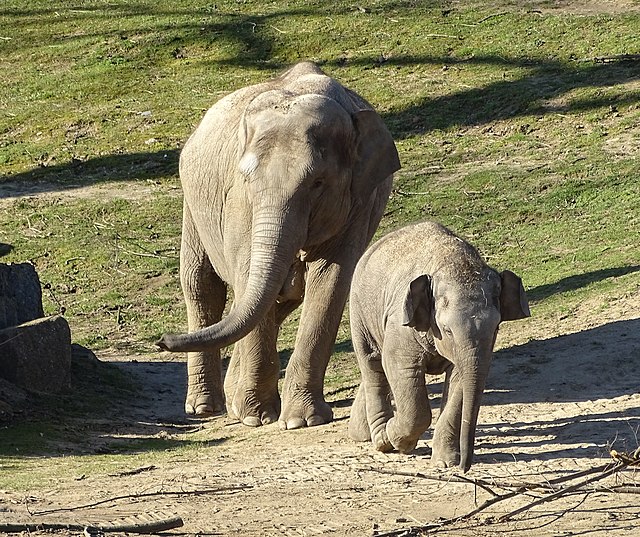
Asian elephants differ significantly from African elephants, not just geographically, but in their physical structure. If you look closely, the first noticeable difference is the shape of their heads. The Asian elephant features a twin dome head, whereas the African elephant has a flatter top. Their ears are also noticeably smaller than those of their African counterparts. Another fascinating feature is the structure of their trunks. While African elephants have two finger like structures at the tip of their trunks, the Asian elephant has only one finger to grasp objects. Furthermore, their backs are slightly arched, giving them a distinct majesty. Their skin color is a dark greyish brown, and they often develop pinkish depigmented patches on their faces and trunks, which increase with age.
Is human greed altering the physical bodies of elephants??
An elephant's tusks are not merely for aesthetics; they are essential tools for survival. According to evolutionary principles, these tusks are actually the elongated incisor teeth of the upper jaw, which continue to grow throughout their lives. Elephants use them to strip bark from trees, dig for water, and defend themselves. However, human greed, driven by the illegal ivory trade, has turned this natural gift into a curse. Due to the excessive poaching of elephants with large tusks, a bizarre genetic shift is now being observed in elephant populations. Many male elephants are being born tuskless or with very small tusks. In scientific terms, this is considered the result of selective poaching, where hunters target only large tusked individuals, leaving only the genes for small or absent tusks to be passed on to the next generation.
ddsd

Why is the Terai region so crucial for elephants?
The Terai Arc Landscape (TAL), stretching across the border of India and Nepal, is considered the largest home for these elephants. This region spans approximately 810 kilometers, from the Bagmati River in Nepal to the Yamuna River in India. This landscape encompasses high mountains, swampy grasslands, and dense forests. Research on the elephants of western Nepal indicates that the males here are quite distinct in size and appearance, with some being counted among the largest Asian elephants in the world. For thousands of years, these elephants have used ancient corridors in search of food and water. For them, borders hold no meaning; they might be in the forests of Nepal in the morning and reach the fields of India by evening. This geographical adaptation makes them the most powerful nomads of this region.
What role did elephants play in royal history?
Flipping through the pages of history, it becomes clear that elephants have always been utilized for power and diplomacy. During the colonial era, elephants played a central role in the hunting expeditions organized in the Terai regions of Nepal and India. The scale at which elephants were used during the visits of the Prince of Wales (who later became King Edward VII and King George V) to Nepal in 1875-76 and 1921-22 seems unimaginable today. Historical records suggest that nearly 600 to 700 elephants were deployed during George V’s visit to Nepal in 1911. The elephants were lined up to form a 'ring' to encircle tigers and rhinos, allowing the royal guests to hunt them. This was the era of hunting diplomacy, where these peaceful creatures were made part of a deadly game.
Is there a contradiction between our culture and modern reality?
In Indian and Nepali culture, elephants are not just considered animals but are revered as living deities. In Hinduism, they are worshipped in the form of Lord Ganesha, the god of wisdom and good fortune. In ancient artifacts, temple carvings, and festivals, the elephant has always been a symbol of dignity and power. They hold the status of 'Gaj', serving as the mounts of kings and the attendants of the gods. The irony is that in the very society where we worship the elephant, we are simultaneously occupying their natural pathways. Deforestation and the establishment of human settlements across elephant corridors are causing fractures in this sacred relationship. Today, the bond between humans and elephants is increasingly based on fear and conflict rather than reverence.
Why is human-elephant conflict increasing along the Indo-Nepal border?
In recent years, human elephant conflict (HEC) has emerged as a major disaster. Incidents of elephant attacks are frequently reported in areas near the Indo-Nepal border, such as Katarniaghat and Shravasti in Uttar Pradesh. In a recent tragic event, an elephant crossing the border killed a woman and injured her children. The primary reason for this is that the traditional routes of elephants are now severed by railway tracks, highways, and agricultural fields. When elephants cannot find their natural paths, they wander into populated areas. While foraging for crops at night, they come face to face with farmers, resulting in heavy losses for both sides. This conflict is not just a regional issue; it is the harsh reality for thousands of families living along these borders.
Can we save elephants from extinction?
Experts believe that the only viable solution is transboundary conservation. The governments of India and Nepal must work collaboratively to secure the movement corridors of elephants. Organizations like the Zoological Society of London (ZSL) and the National Trust for Nature Conservation (NTNC) are working to increase community tolerance in the Terai region. This involves educating local communities about elephant behavior, utilizing solar fencing, and installing early warning alarm systems when elephants approach. This conflict can only be mitigated if local people begin to view elephants as a part of their environment rather than as their enemies. Conserving elephants is not just about saving a single species; it is about protecting the entire ecosystem that provides water and fresh air to millions of people.
Elephants are the engineers of the Earth. They forge new trails through forests, disperse seeds, and maintain the balance of the ecosystem. If these grey ghosts vanish due to our negligence, not only will a massive part of our culture die, but our environment will also collapse. This shared heritage between India and Nepal is now our collective responsibility. Will we return these ancient corridors to the elephants, or will we simply watch as they vanish forever? The future rests entirely on the decisions we make today.
Sources:
https://tinyurl.com/2blrhtaw
https://tinyurl.com/28p7p5hs
https://tinyurl.com/294xqzk6
https://tinyurl.com/26gs8zfo
https://tinyurl.com/286ymjm5
https://tinyurl.com/ybtgt9w5
https://tinyurl.com/239lb9ak
https://tinyurl.com/24kfe62m
https://tinyurl.com/2b97hze7