


Timelines 10
Man and his Senses 10
Man and his Inventions 10
Geography 10
Fauna 10
Timelines 10
Man and his Senses 10
Man and his Inventions 10
Geography 10
Fauna 10
Nature often hides its most precious secrets in the harshest and most barren places. The Calotropis gigantea or Aak plant, which grows without any special care in the dry regions of India and Nepal, is a prime example of this. At first glance, it might seem like an ordinary wild shrub that leaks a thick, milky, and poisonous sap when broken. However, from the perspective of both science and spirituality, this plant is a miracle. For centuries, its beautiful crown shaped flowers have been considered sacred for the worship of Lord Shiva in Hinduism. At the same time, modern medical science and ancient Ayurveda have found it to be highly effective in healing wounds, reducing inflammation, and treating serious respiratory issues like asthma. This article examines how a toxic wild plant has evolved into an integral component of the ecology, culture, and traditional medicine of the Indian and Nepalese subcontinent.
How does this plant survive in dry and barren lands?
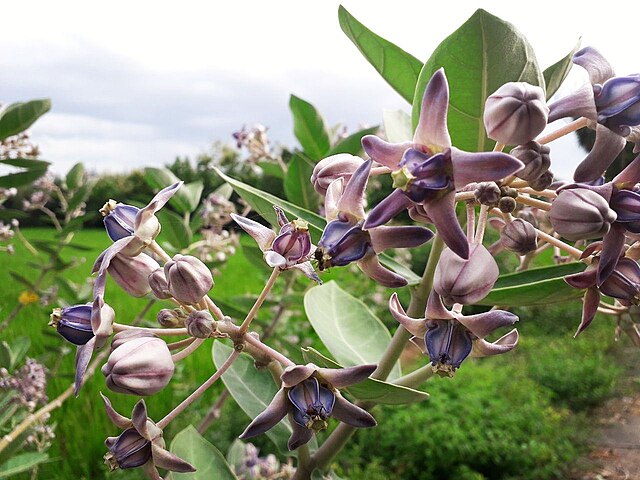
Calotropis gigantea is primarily native to the tropical regions of India, Nepal, China, and Southeast Asia. It is a large shrub that can grow to a height of about four meters. Its leaves are light green, thick, and oval, while its stems are cylindrical and somewhat hollow inside. The most prominent feature of this plant is its milky sap which flows out immediately if any part of the plant is cut or broken. This sap is naturally very bitter and toxic, containing complex chemicals such as cardiac glycosides and calcium oxalate. This poisonous quality protects the plant from grazing animals, allowing it to flourish easily in barren soil without any human help. Furthermore, the plant is extremely important for the environment. Its beautiful white or light purple waxy flowers have a unique crown that attracts various insects and butterflies. This process of pollination not only maintains local biodiversity, but when its fruits dry up, the seeds spread far and wide through the wind. Its deep roots also play a key role in binding loose and sandy soil to prevent erosion.
What is its significance in Ayurveda and ancient medicine?
Since ancient times, this plant has held a distinct place in traditional Indian medicine and Ayurveda. In historical Vedic texts and Ayurvedic records, it is known as Shweta Arka. Traditional healers have recognized its medicinal properties for centuries. Its leaves, roots, flowers, and even its milky sap have been used to treat various diseases. According to traditional medicine, this plant has an amazing ability to cure stomach problems, digestive system failures, and serious respiratory disorders such as asthma and cough. Its leaves are heated and tied over areas of swelling and joint pain, providing immediate relief. Additionally, it has been used as a remedy for leprosy, skin infections, and even as an antidote for snake bites. Although its sap is poisonous, skilled healers used to purify it and use it in medicines in very controlled quantities. This is proof that the people of ancient India had a deep and accurate understanding of the chemical properties of plants and their therapeutic uses.
How have traditional healers used it for respiratory and skin ailments?
Various research papers and medical databases make it clear that the use of this wild plant in the field of medicine is not based on hearsay alone. This plant is a natural storehouse of chemicals that can fight many complex diseases of the body. Its flowers were dried and powdered to be added to traditional decoctions for treating respiratory diseases like asthma, colds, and chest congestion. Meanwhile, the bark of its stem and root was used to reduce fever and kill intestinal worms. Interestingly, the sap of this plant has also been used for direct application in diseases like fungal skin infections and eczema. In rural areas, where modern medical facilities are still not easily available, local practitioners apply a paste of this plant extract to heal wounds quickly and stop bleeding. The alkaloids, tannins, and flavonoids found in this plant make it a potent natural remedy that strengthens the body’s ability to combat harmful bacteria.

What does modern science say about its medicinal properties?
Modern science and laboratory tests have now confirmed many of the claims that Ayurveda has been making for centuries. Studies conducted by national health institutes have deeply analyzed the phytochemical structure and biological effects of its extract. These scientific tests found that the leaves and sap of this plant have strong antimicrobial and antioxidant properties. In one significant study, a special protein was isolated from the milky sap of this plant. When this protein was tested, it was observed to be highly effective in stopping the growth of dangerous and infectious bacteria. Additionally, tests conducted on rats proved that the extract of this plant can heal wounds remarkably within fourteen days, which is as effective as standard drugs available in the market. Compared to modern medicines, the extract prepared from this plant helps in the formation of new tissues without damaging skin cells. This scientific discovery confirms that this wild plant can be used on a large scale in the future to create new and safe medicines.
Is its use in modern medicine completely safe?
Any traditional herb is recognized in modern medicine only when it meets strict scientific standards. In the case of this plant as well, scientists have tested its extract with various solvents so that its most effective elements can be extracted safely. Researchers found that although the raw sap of the plant can be extremely dangerous for the eyes and skin, and direct contact can even lead to blindness, its toxic effects are greatly reduced when processed scientifically. Its various extracts have shown the highest inhibitory capacity against many types of bacteria and fungi in the laboratory. Furthermore, studies have also shown that extracts taken using the right solvent have low hemolytic activity, which means they do not damage red blood cells. This simply means that this plant could prove to be a boon for the future pharmaceutical industry. The natural defense system of this plant, which keeps it alive in harsh barrens, is the same chemical system that is now showing a new way to protect humans from dangerous infections.
What is the place of this flower in Hinduism and the worship of Lord Shiva?
Beyond science and botany, the roots of this plant are connected to deep cultural and spiritual beliefs in India and Nepal. In Hinduism, the Aak flower is considered extremely sacred and is an integral part of the worship of Lord Shiva. According to the Shiva Purana, offering this flower to Lord Shiva is considered an act of great merit. But the question is, why does Shiva like this poisonous flower? From a spiritual point of view, this plant blooms even in the harshest and most adverse conditions, which is a symbol of detachment or renunciation from worldly attractions. Lord Shiva himself is a supreme ascetic, so this flower reflects this aspect of him. It is also believed that Lord Shiva accepts things that are rejected by society or nature, or things that are toxic. Offering these flowers in worship is a symbol of surrendering one's ego, vices, and impurities before God. There is a strong belief that offering Aak leaves and flowers on the Shivalinga pleases Lord Shiva quickly, bringing peace to life and completely destroying negative karma.
Why are the leaves used specifically in ancient rituals?
The purity of this plant is not limited to Lord Shiva alone, but it also has a very special significance in the worship of the Sun God. According to the Hindu calendar, the leaves of this plant are used for a very important ritual on the auspicious occasion of Ratha Saptami. Ratha Saptami is the day when Lord Surya brings his chariot in the right direction for the journey ahead and scatters his energy on earth. On this day, devotees are instructed to wake up at dawn and take a bath by placing seven Aak leaves on their head and other parts of the body. According to religious beliefs, doing this washes away the past sins of a person and provides relief from long lasting diseases. Mythological stories mention that even during the time of the Mahabharata, Maharishi Vyasa suggested to Bhishma Pitamah to bathe with these seven leaves that absorb the Sun's energy to free him from his sins. It is believed that these leaves have a special natural ability to soak up the infinite energy of the Sun and transmit it to the body. In this way, this simple looking plant has been acting as a strong bridge between deep faith, good health, and nature for centuries.
Sources:
https://tinyurl.com/2b6ppjaj
https://tinyurl.com/27lvnoqf
https://tinyurl.com/2cl5xjl5
https://tinyurl.com/2yn6887u
https://tinyurl.com/22s7q8dv
https://tinyurl.com/2a8jj6ba
https://tinyurl.com/2dja4nfm